Central Limit Theorem
Statistical Inference - STA258 We have a population of any type or shape:
From the same population, if we take samples of size n
Sample 1 Sample 2 … Sample 10 000 … } n … } n … } n X 1 ¯ X 2 ¯ X 10000 ¯
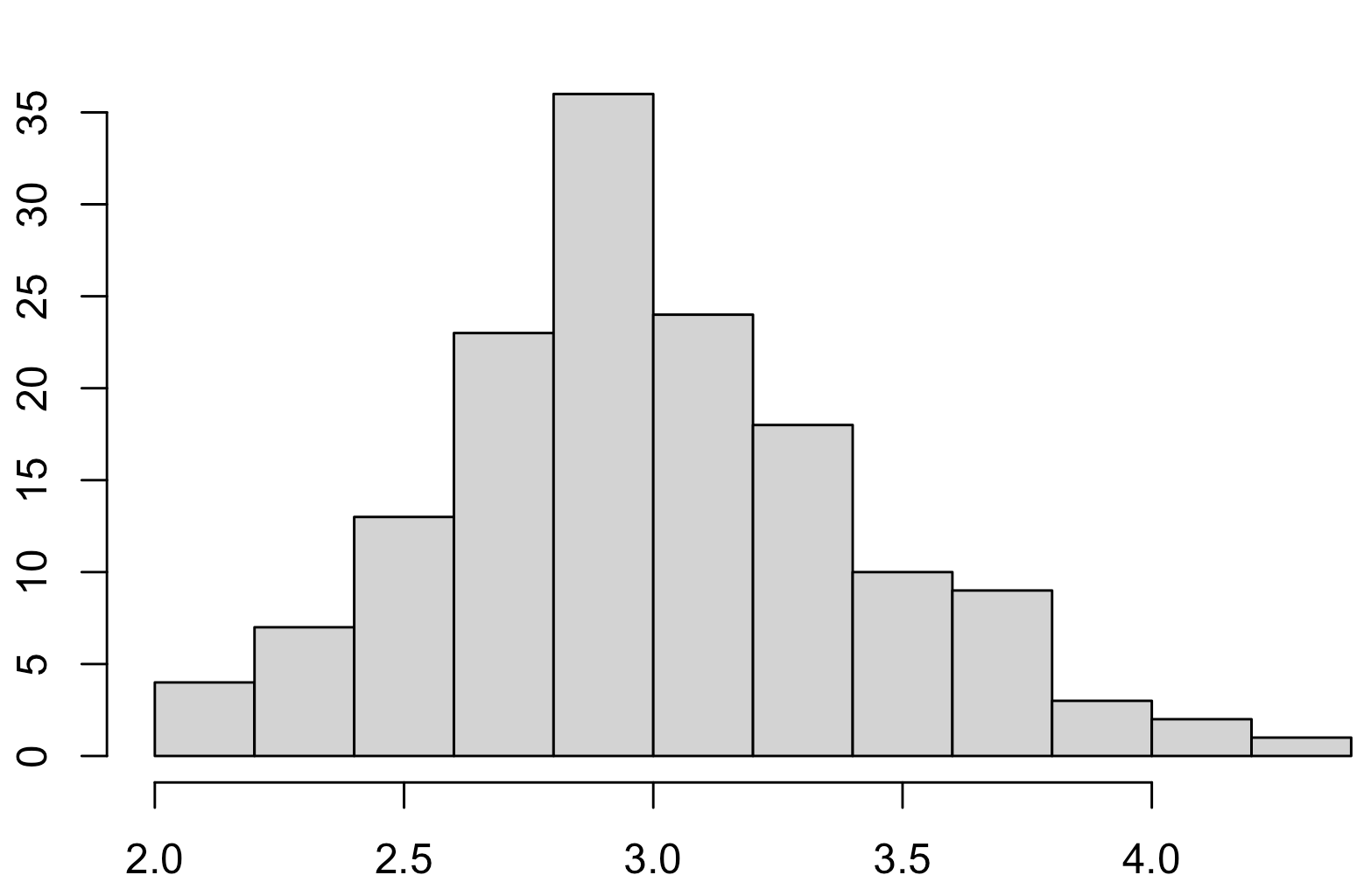
Then we can create a distribution for our collection of X ¯
Doesn't matter what the population is, the collection will be a bell curve.
X ¯ → D N ( μ , σ 2 n ) μ X ¯ = μ σ X ¯ 2 = σ 2 n
So Central Limit Theorem tells us that:
X ¯ → D N ( μ , σ 2 n ) X ¯ − μ σ n → D N ( 0 , 1 ) Even if you use Sample Variance , X ¯ − μ S
We can normalize it.
The transformation is Z = x − μ σ
Working with samples of size n Z = X ¯ − μ σ n
As n + + X ¯ 30
Example:
X ¯ Gamma Distribution with α = 2 β = 4 Sample size 128
X ¯ = X 1 , X 2 , … , X 128 X ¯ ∼ Γ ( 2 , 4 ) μ = α β = ( 2 ) ( 4 ) = 8 σ 2 = α β 2 = ( 2 ) ( 4 ) 2 = 32 σ = 32 = 4 2 Approximate P ( 7 < X ¯ < 9 )
Z = X ¯ − μ σ n Z = X ¯ − 8 4 2 128 = 2 X ¯ − 16
P ( 7 − μ < X ¯ − μ < 9 − μ ) P ( 7 − μ σ n < X ¯ − μ σ n < 9 − μ σ n ) P ( 7 − μ σ n < Z < 9 − μ σ n ) P ( 7 − 8 4 2 128 < Z < 9 − 8 4 2 128 ) P ( 7 − 8 4 2 128 < Z < 9 − 8 4 2 128 ) 7 − 8 4 2 128 = − 2 9 − 8 4 2 128 = 2 P ( − 2 < Z < 2 ) Go to the table, find 2.0
0.9772 1 − 0.9772 = 0.0228 By symmetry
Bottom is 0.0228
We have 0.9772 − 0.0228 = 0.9544
We just need our parent distribution to have a first and second moment.
If we draw samples from any population (doesn't need to be normal or even continuous or discrete), which has a 1st, 2nd moments. Let the samples be of size n
Sample 1 : n , Sample 2 : n , … , Sample 10000 : n X ¯ 1 X ¯ 2 … , X ¯ 10000 We have here, a large collection of X ¯
Then we can create a distribution for the collection of sample means (not the actual samples).
If you see an example histogram of the means. It resembles a normal distribution.
This is the sampling distribution of X ¯
So X ¯ ∼ N ( μ X ¯ = μ , σ X ¯ 2 = σ 2 n )